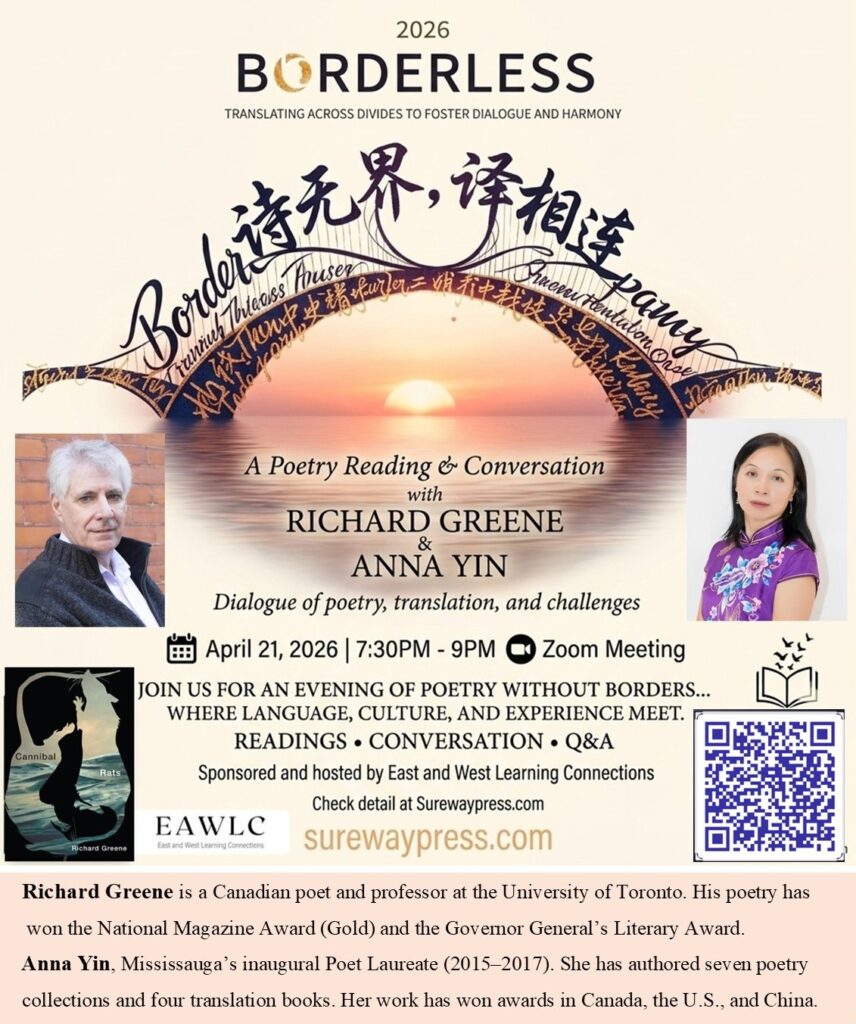
To celebrate National Poetry Month, East and West Learning Connections will host an online event: Borderless: Richard Greene and Anna Yin on Cannibal Rats, on April 21. Here is the detail.
Come to join two poets for an intriguing evening exploring poetry, translation, human condition and life experience intertwined in between, and contribute your own perspective and interpretation!
Time: Tuesday April 21, 2026 at 7:30-9 P.M. (Eastern Time)
Free English Online Event, transcript in other languages available on Zoom
Zoom registration link: https://us02web.zoom.us/meeting/register/geAuyyiWSzSLfnubOpZocQ
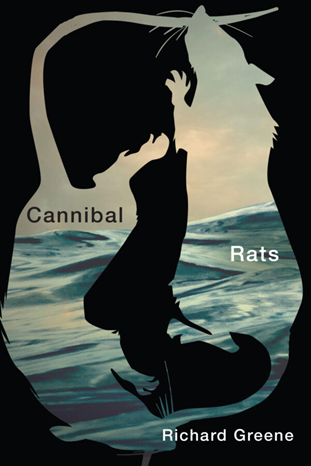
Richard Greene will share poems from his new collection Cannibal Rats, works that both engage and illuminate what was once called “the human condition.” Using the book as a lens on historical injustices and their resonance in today’s chaotic world, we will explore what history teaches us—or fails to teach—and how shifting human destinies intertwined with the lives of animals.
He will also speak about his personal experiences, including his battle with cancer and his mother’s illness, and how these shape the emotional and thematic core of the title poem and the collection as a whole. Reflecting on the value of poetry and art—especially in translation—he will offer insights into their enduring relevance.
Anna Yin will share her Chinese translation of Richard’s Cannibal Rats, along with her challenges and discoveries in navigating its historical and cultural allusions within both a Canadian and personal context. The audience will be invited to join the discussion, contributing perspectives on translation, culture, and interpretation.

Richard Greene, a Newfoundlander, teaches creative writing at the University of
Toronto. He is the author of internationally acclaimed biographies of Edith Sitwell and
Graham Greene. His fifth collection of poetry, Cannibal Rats, has just been released by
Vehicule Press. His poetry has been recognized with the National Magazine Award
(Gold) and the Governor General’s Literary Award.

Anna Yin was Mississauga’s inaugural Poet Laureate (2015–2017) and is the author of seven poetry collections, including Breaking Into Blossom (Frontenac Press, 2025). She has translated four poetry books, notably Mirrors and Windows (Guernica Editions, 2021). Her work has appeared in Queen’s Quarterly, ARC Poetry, The New York Times, China Daily, CBC Radio, and more. She has read on Parliament Hill, at international festivals, and at universities in China, Canada, and the U.S. A recipient of multiple awards and grants, she created and teaches Poetry Alive to bring poetry into schools, colleges, and communities.
By Richard Greene
Blue steel rusted by the sea, it was worth
only its salvage, years of South and North
Poles eating at her, while the rats who had run
aboard on mooring ropes were eating son
and daughter bred inside her belly—
generations of need in the galley
and the staterooms. No one wanted to own
her dereliction in this changed town,
so she sat there, the Lyubov Orlova.
Cash from Hibernia and Terra Nova
cancelled what we once knew about shipwrecks,
when green water ran on the slanted decks
of wood ships broached to and on their beam ends
remembered in folk songs where nothing mends.
Revenant myself, I may not cavil
about how art and memory unravel,
followed my chances on the mainland,
got tenure, found the taxpayers’ open hand,
and am now a Jonah where I was born,
confused by both the fog and the foghorn;
returning to my peculiar Nineveh,
I have no message: I’ve just been away.
A tugboat dragged that ghost ship out to sea,
lost it when a rope broke or they let it free
just outside this country’s jurisdiction.
The Irish papers loved the rodent fiction
and supposed it landing soon in Galway,
full of cannibal rats looking for new prey.
It joined all that history of drowned fleets,
without song or poem but a million tweets.
first published in the Walrus in 2018
饥噬之鼠(trans Anna Yin)
海水锈蚀的青铜绿铁,所谓价值
不过废铜烂铁,多年来南极与北极
啃蚀她,而沿泊绳窜入邮轮的老鼠,
在厨房以及舱室内部,
噬食她腹中繁衍的子嗣。
这个变迁的小镇无人愿意
认领败落的她,于是
“柳博夫·奥尔洛娃号”就那样搁置。
希伯尼亚与泰拉诺瓦的石油财富
改写我们对沉船残骸的认知,
曾经绿水漫上倾斜的甲板,
那些在风浪里颠覆的木船
民谣里被传唱,却无从修复。
归来的我,也无意探寻
艺术与记忆如何剥离松散。
我曾追随机遇远赴大陆,
得以终身教职,蒙受纳税人资助。
如今在出生之地,我沦为约拿,
在迷雾与雾号之间不知所措;
重返那离奇的“尼尼微”,
我无话可说——不过是离开过。
那幽灵船被拖船拖向大海,
恰在这个国家的管辖界外,
绳索断裂,或被悄然遗弃。
爱尔兰媒体沉迷荒诞怪事,
猜测它很快登陆戈尔韦——
满载鼠群觅食新的猎物。
它融入沉没舰队的历史,
无诗无歌,却有推文无数。
On Translating “Cannibal Rats” by Richard Greene
My first encounter with “Cannibal Rats,” published in The Walrus, was shaped by the shock of its title. Yet I sensed early on that the poem pointed beyond its surface image. The opening scene—a derelict ship overrun by rats forced into cannibalism—seems self-contained, but the poem quickly fragments into shifting registers: offshore oil wealth, remembered shipwrecks, folk song, and the poet’s own return home without message.
What first appeared disconnected gradually revealed a deeper coherence. The image of “cannibal rats” becomes a governing metaphor for closed systems that, cut off from renewal, turn inward and consume themselves. This logic extends beyond the ship: to cultural memory displaced by economic progress, to the poet’s diminished role as bearer of meaning, and to a media landscape that transforms reality into sensational narrative—“rodent fiction”—circulating without depth.
To translate this poem required not only linguistic attention but sustained return. In doing so, I came to see how it resists fixed truth, instead exposing how truth is altered, retold, and consumed. I hope this translation carries that tension to its readers. ———— Anna Yin, April 9, 2026